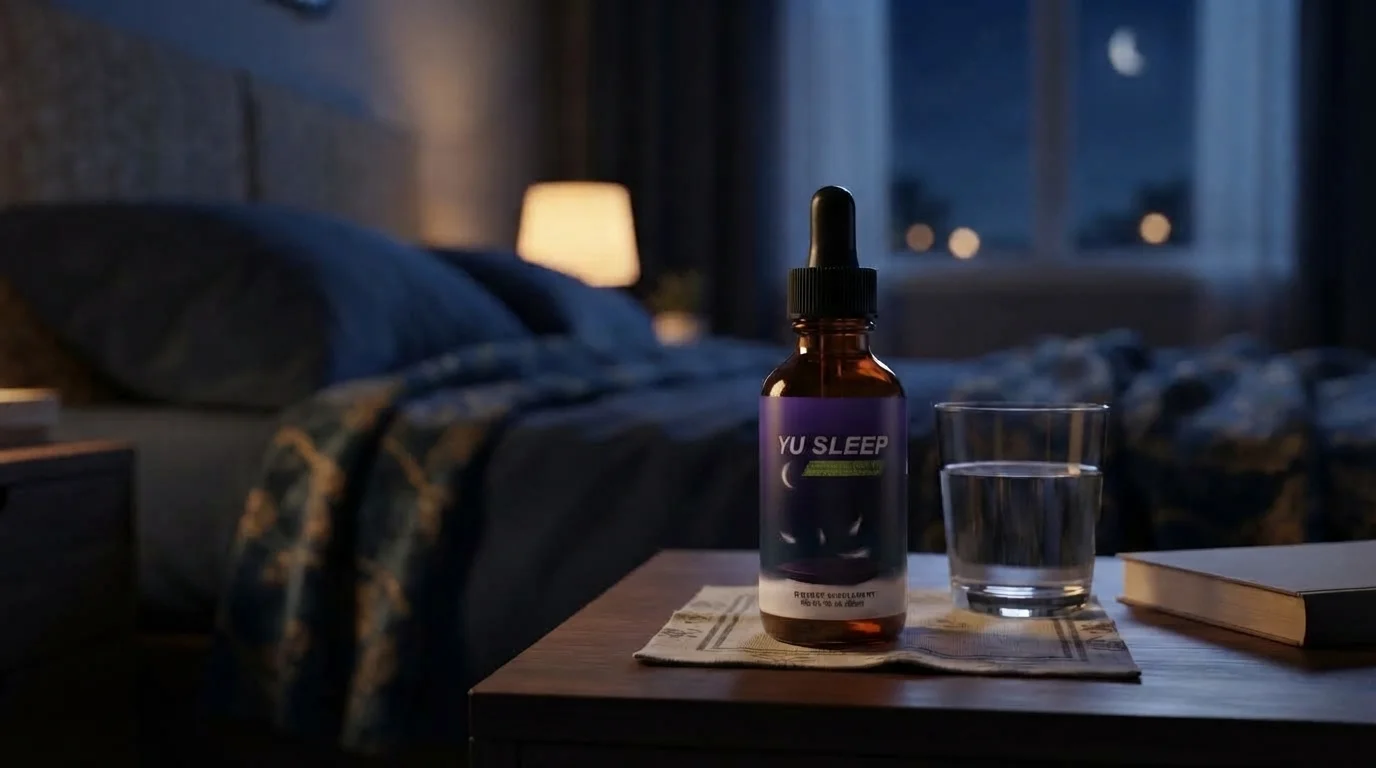
Yu Sleep isn’t a scam in the sense of taking your money and sending nothing — it’s a real liquid supplement with common, legitimate sleep-support ingredients (melatonin, magnesium glycinate, GABA, tart cherry extract). The caution is around its marketing: an unverifiable “study,” a named researcher with no independent record, and a flood of near-identical review articles online. None of that means the product doesn’t work — it means the marketing shouldn’t be taken at face value.
“Scam or legit” is usually the wrong question for a supplement like this — the ingredients are real and the checkout works. The more useful question is which specific claims you should trust, and which ones are unverifiable marketing you should set aside before deciding.
What Yu Sleep Actually Is
Strip away the marketing language and the ingredient list itself is unremarkable in a good way — these are commonly studied sleep-support compounds, not exotic or unregulated substances.
Yu Sleep is a liquid drop formula built around low-dose melatonin (0.9mg), magnesium glycinate, GABA, L-theanine, 5-HTP, tart cherry extract, lemon balm, apigenin, and B vitamins. Every one of these shows up regularly in other reputable sleep-support products, and several have real research behind their general category of use (magnesium and sleep quality, low-dose melatonin and sleep onset, for example). The formula itself isn’t the exotic part — it’s a fairly conventional sleep-support stack delivered as a liquid instead of a capsule.
The Claims That Don’t Hold Up to Scrutiny
This is the part that actually warrants caution — not the ingredients, but specific claims layered on top of them.
Yu Sleep’s sales material references an in-house study (thousands of participants, specific improvement percentages) and a named lead researcher with decades of sleep-research experience. We looked for independent verification of both — publication records, professional profiles, any trace outside the product’s own marketing — and found none. That doesn’t prove either is fabricated, but it means neither should be treated as an established fact. Similarly, claims linking the product to unintentional weight loss are the kind of specific health outcome claim that a dietary supplement in the U.S. isn’t allowed to make with backing, and should be read as anecdotal marketing rather than an expected result.
Reasonably Solid
- The core ingredient list and typical dosing
- Low-dose melatonin approach (vs. high-dose alternatives)
- Standard FDA supplement disclaimer present
- A real, processable checkout (BuyGoods/ClickBank-style)
Treat With Skepticism
- The cited “study” (no independent record found)
- The named lead researcher (no independent record found)
- Weight-loss / GLP-1 framing
- Specific numeric result claims (e.g. exact % improvement)
The Templated Review Problem
Search for this product and you’ll find dozens of “review” articles with nearly identical wording, published across unrelated sites — including forum platforms and, in at least one case, a hijacked academic institution’s web form. This is a known pattern in affiliate marketing for supplements: low-effort, copy-pasted content designed purely to rank in search results, not to genuinely evaluate the product. Their existence isn’t evidence the product is bad — but it does mean you should discount star ratings and “verdicts” from sites that read like templates, and rely on the ingredient list and your own research instead.
Don’t Confuse It With a Similarly Named Product
“YuSleep” and “YuGap Sleep Spray” are genuinely different products from different companies — worth double-checking before you buy.
A separate product, the YuGap Melatonin Sleep Spray, is sold by a different company (YuGap Wellness) as an oral spray rather than drops, and is a different formulation and business entirely. The near-identical branding is a common source of mix-ups in this category, and it’s worth confirming you’re looking at the product and company you actually intend to buy before checkout.
Where It’s Actually Sold
Yu Sleep is promoted through an affiliate program, so you’ll find it hosted on several different domains (each run by a different marketer), all ultimately processing payment through the same checkout system. This isn’t unusual for direct-response supplements, but it does mean there’s no single canonical “official site” to check against — the ingredient list and price are the more reliable things to compare across versions, not which domain looks most official.
Considering Trying It?
We currently point readers to Yu Sleep’s official checkout page.
See Current Pricing →Frequently Asked Questions
Is Yu Sleep a scam?
Yu Sleep is a real, purchasable supplement with a fairly standard ingredient list, so it isn’t a scam in the sense of taking money and delivering nothing. That said, its marketing includes an unverifiable in-house study and a named “lead researcher” with no independent record, which are red flags worth knowing before you buy.
Is Yu Sleep the same as YuGap Sleep Spray?
No. Yu Sleep is a liquid drop formula sold through a BuyGoods checkout funnel. YuGap Sleep Spray is a different product from a different company (YuGap Wellness), sold as an oral spray. The similar names are a common source of confusion, not the same product.
Why are there so many websites selling Yu Sleep?
Yu Sleep is promoted through an affiliate marketing program, meaning many independent marketers each run their own version of the sales page, often on different domains. This is a common and legal setup, but it also means there’s no single “official” site, and the marketing copy is frequently reused word-for-word across many of them.